
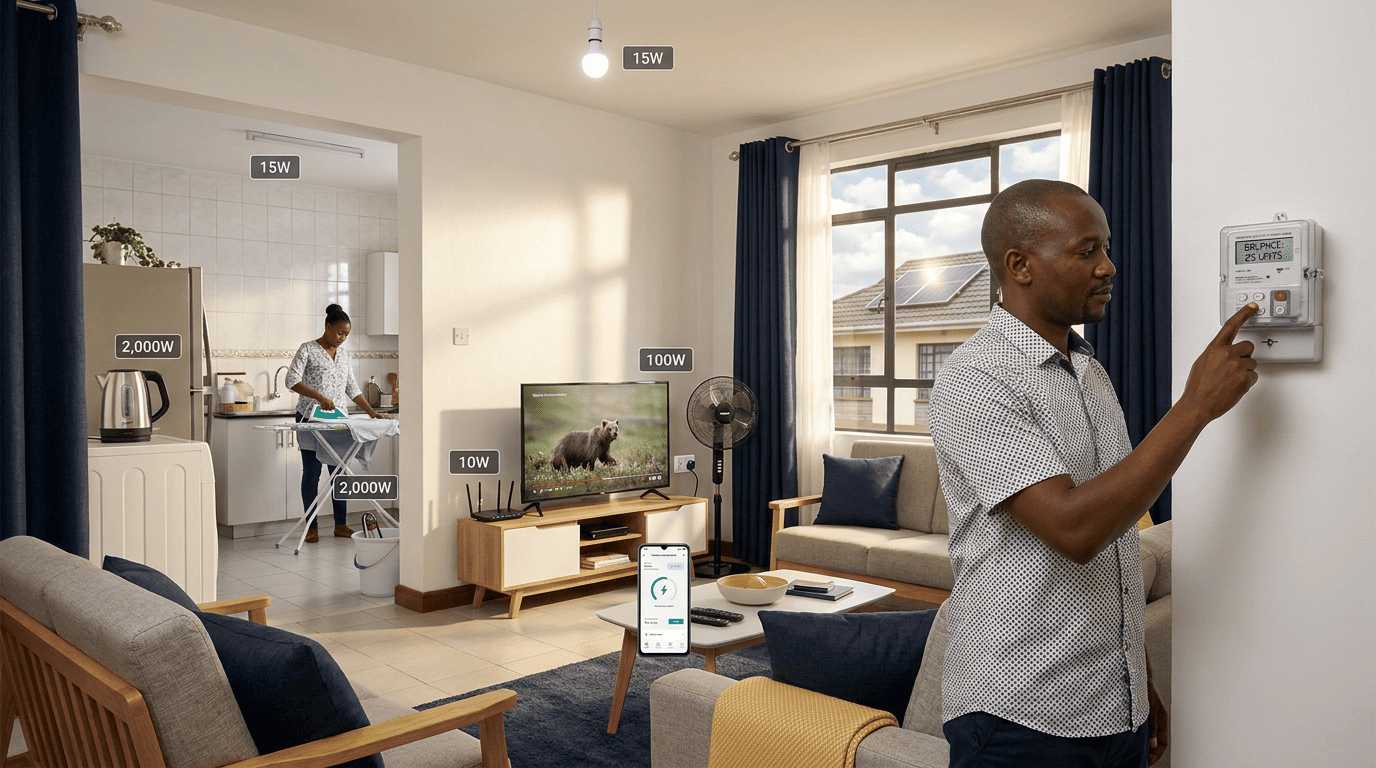
Household Appliances and Their Power Consumption in Kenya
Household Appliances and Their Power Consumption in Kenya: How Many Units Do They Use?
Have you ever purchased KSh 100 worth of electricity tokens and wondered why the units seem to disappear so quickly? Perhaps you leave your Wi-Fi router running throughout the day, use an electric kettle several times, or keep a fan running for hours because of the heat.
For other households, electricity consumption increases during colder periods, when water heaters, electric kettles and room heaters become more important for preparing hot beverages, bathing and keeping indoor spaces warm.
Understanding how much electricity household appliances consume can help you identify where your power goes and make informed decisions when buying new appliances.
Every electrical appliance has a power rating, usually expressed in watts (W). This tells you how much electrical power it uses when operating at that rating. The amount of electricity it consumes depends on both its power rating and how long it operates.
For Kenyan households using prepaid electricity meters, commonly known as token meters, understanding these figures can make electricity consumption easier to monitor.
This guide explains the power consumption of common household appliances, how many electricity units they use per hour, why some appliances consume more power than others, and practical ways to manage household electricity use.
1. Understanding Watts, Kilowatts and Electricity Units
Before comparing household appliances, it helps to understand three basic terms.
What Is a Watt (W)?
A watt is a unit of electrical power. It indicates how much power an appliance uses while operating under specified conditions.
For example:
- An energy-saving LED bulb might be rated at 9W.
- A Wi-Fi router might be rated at 10W.
- A television might use around 100W.
- An electric kettle might be rated at 2,000W.
- An instant electric shower might be rated at 5,000W.
These are illustrative ratings. Actual figures vary depending on the appliance model and operating conditions.
What Is a Kilowatt (kW)?
A kilowatt is equal to 1,000 watts.
Therefore:
- 10W = 0.01kW.
- 100W = 0.1kW.
- 500W = 0.5kW.
- 1,000W = 1kW.
- 2,000W = 2kW.
- 5,000W = 5kW.
What Is One Unit of Electricity?
A unit of electricity is one kilowatt-hour (kWh).
One kilowatt-hour is the amount of electrical energy consumed when an appliance using 1,000W operates continuously at that power level for one hour.
For example, an electric water heater rated at 1,000W consumes approximately one unit for every hour it operates continuously at that rating.
If it operates for 30 minutes, it consumes approximately half a unit.
An electric kettle rated at 2,000W would consume two units if it operated continuously at that rating for an entire hour. However, because a kettle normally boils water in a few minutes, its actual consumption per use is much lower.
The important difference is that watts measure power, while kilowatt-hours measure electricity consumed over time.
How to Calculate Electricity Consumption
Use this simple formula:
Units consumed = Appliance wattage × Operating hours ÷ 1,000
For example, a 100W television operating for four hours would consume:
100 × 4 ÷ 1,000 = 0.4 units.
A 2,000W electric kettle operating for five minutes would consume:
2,000 × (5 ÷ 60) ÷ 1,000 = approximately 0.167 units.
This calculation can help you estimate the electricity consumption of different appliances in your home.
2. How Many Electricity Units Do Common Household Appliances Consume Per Hour?
The table below compares illustrative power ratings for appliances commonly found in Kenyan households.
The figures show how many units each appliance would consume if it operated continuously at the stated power rating for one hour.
| Household appliance | Illustrative power rating | Units consumed per hour |
|---|---|---|
| Energy-saving LED bulb | 9W | 0.009 |
| Traditional incandescent filament bulb | 60W | 0.060 |
| Wi-Fi router | 10W | 0.010 |
| Radio | 15W | 0.015 |
| Phone charger actively charging | 10W | 0.010 |
| Small desk fan | 35W | 0.035 |
| Ceiling fan | 60W | 0.060 |
| Laptop | 60W | 0.060 |
| Modern LED television | 100W | 0.100 |
| Desktop computer | 200W | 0.200 |
| Blender | 500W | 0.500 |
| Washing machine during a powered operating phase | 500W | 0.500 |
| Electric iron | 1,200W | 1.200 |
| Electric kettle | 2,000W | 2.000 |
| Electric water heater | 1,000W | 1.000 |
| Electric room heater | 2,000W | 2.000 |
| Instant electric shower | 5,000W | 5.000 |
These are illustrative figures, not universal ratings. Always check the appliance’s label or user manual for its actual power rating.
The table also does not represent typical daily consumption for every appliance. A washing machine may use different amounts of power during different stages of a cycle. An electric iron or room heater may switch its heating element on and off automatically. A refrigerator operates intermittently rather than consuming its maximum rated power continuously.
The key lesson is that an appliance’s power rating tells you how quickly it can consume electricity, while its operating time helps determine the total number of units used.
3. Electric Kettles and Water Heaters: How Much Electricity Do They Use?
Many Kenyan households use an electric kettle to prepare tea, coffee and other hot beverages. Others use electric water heaters or immersion heaters to heat water for bathing.
These appliances can have relatively high power ratings, but the electricity they consume depends heavily on how long they operate.
Consider a 2,000W electric kettle.
If it takes five minutes to boil water, its estimated consumption is:
2,000 × (5 ÷ 60) ÷ 1,000 = approximately 0.167 units.
If you boil water four times a day under similar conditions, the estimated consumption would be approximately 0.67 units per day.
Over 30 days, that would amount to approximately 20 units.
Actual consumption depends on the amount and starting temperature of the water, the kettle’s efficiency and how long it takes to reach boiling point.
Now consider a 1,000W immersion water heater.
If it operates continuously at its rated power for 30 minutes, it consumes approximately 0.5 units.
If it operates for one hour, it consumes approximately one unit.
These examples show why the number of minutes an appliance operates can matter as much as its power rating.
What Happens When You Use Hot Water More Frequently?
During colder periods, including parts of Kenya’s cooler July weather, some households may boil water more frequently for bathing and hot beverages.
This can increase electricity consumption, especially if water heating becomes a daily routine.
A practical approach is to heat only the amount of water needed. For example, if you only need enough hot water for one or two cups of tea, heating a full kettle may be unnecessary.
Similarly, when using an immersion heater, avoid heating more water than required.
Safety reminder: Immersion heaters must be used according to their manufacturer’s instructions. Disconnect the power before removing the heater from the water, and never touch the water while the heater is connected to electricity.
4. Wi-Fi Routers: The Small Appliances That Run All Day
Unlike a kettle or iron, a Wi-Fi router may remain switched on throughout the day and night.
A router rated at 10W consumes approximately 0.01 units per hour if it draws 10W continuously.
That works out to:
- 0.24 units per day.
- 7.2 units over 30 days.
- 87.6 units over 365 days.
This illustrates why a low-power appliance can contribute to household electricity consumption when it operates continuously.
The actual consumption depends on the router model, its power supply, connected equipment and operating conditions.
For many households, keeping the router on is necessary for internet access, security cameras, smart devices or work. Switching it off when it is genuinely not needed may save some electricity, but it is important to weigh that saving against the convenience and function of the connection.
The same principle applies to other devices that remain powered throughout the day.
A small appliance does not necessarily consume a large amount of electricity in an hour, but continuous operation can add up over weeks and months.
5. Does Leaving a Television or Decoder on Standby Consume Electricity?
Many households switch off a television using its remote control without disconnecting it from the power supply.
Depending on the model, the television may enter standby mode rather than switch off completely.
In standby mode, some electronic components remain powered so the television can respond to the remote control, maintain certain functions or start more quickly.
Decoders, gaming consoles, sound systems and other entertainment electronics may also consume electricity in standby mode.
The amount varies significantly by model. Some newer devices use very little standby power, while older or less efficient devices may use more.
For illustration, suppose a device consumes 2W in standby mode for 20 hours each day.
Its daily standby consumption would be:
2 × 20 ÷ 1,000 = 0.04 units.
Over 30 days, that would amount to 1.2 units for that device.
If several devices remain in standby mode, their combined consumption can become more noticeable.
However, standby consumption should be considered in perspective. A device drawing only a small amount of power in standby mode may use considerably more when actively operating.
Should You Switch Off Entertainment Electronics at the Wall?
If a television, decoder, sound system or gaming console is not being used, switching it off fully at the wall may reduce standby consumption where the device would otherwise continue drawing power.
However, some equipment needs to remain connected for updates, recordings, network functions or other features.
Check the manufacturer’s instructions before disconnecting equipment, especially devices that record programmes or perform scheduled updates.
The aim is not to unplug every electronic device constantly. It is to identify unnecessary consumption and avoid leaving equipment running when there is no practical reason for it.
6. Traditional Bulbs Versus Energy-Saving LED Bulbs
Lighting is another area where households can reduce electricity consumption.
Traditional incandescent filament bulbs produce light by heating a thin wire until it glows. Much of the electricity they consume is converted into heat rather than visible light.
LED bulbs use a different technology and can provide similar brightness while consuming considerably less electricity.
Consider two bulbs:
- Traditional incandescent bulb: 60W.
- LED bulb: 9W.
If each bulb operates for eight hours a day, their estimated consumption would be:
| Lighting type | Power rating | Units per hour | Units over eight hours |
|---|---|---|---|
| Incandescent filament bulb | 60W | 0.060 | 0.480 |
| LED bulb | 9W | 0.009 | 0.072 |
The 60W filament bulb consumes approximately 0.48 units over eight hours, while the 9W LED bulb consumes approximately 0.072 units.
The difference is approximately 0.408 units per day for just one bulb.
Over 30 days, that amounts to approximately 12.24 units saved by using the LED bulb, assuming the stated power ratings and equal operating times.
A household with several lights may achieve a more noticeable reduction by replacing frequently used incandescent bulbs with suitable LED alternatives.
When buying replacement bulbs, compare their brightness, measured in lumens, as well as their wattage. A lower-wattage bulb is only a useful replacement if it provides sufficient light for the intended space.
7. Do Modern Televisions Consume More Electricity Than Old CRT Televisions?
Television technology has changed significantly over the years.
Older cathode-ray tube televisions, commonly known as CRT televisions, were bulky and used a different display technology from modern flat-screen televisions.
Modern televisions include LED-backlit LCD models, OLED televisions and other display technologies. Their electricity consumption depends on screen size, brightness, picture settings, display technology and the content being shown.
It is therefore not accurate to say that every modern television consumes more electricity than every old CRT television.
However, a large modern television can consume more electricity in absolute terms than a smaller older television, particularly when the newer screen is much larger or operated at high brightness.
Modern LED televisions can also be more energy-efficient for a comparable screen size. The actual comparison depends on the models being considered.
Does a 50-Inch 4K Television Use More Electricity?
A 50-inch 4K television has a screen designed to display a high-resolution picture. The resolution alone does not determine its electricity consumption.
A 4K television may consume more or less power than another television depending on its technology, brightness, energy efficiency and operating settings.
The most important consideration is often the combination of screen size and viewing time.
For example, suppose a household uses a television rated at 100W for six hours every day.
Its estimated daily consumption would be:
100 × 6 ÷ 1,000 = 0.6 units.
Over 30 days, that would amount to 18 units.
If a larger television consumes 150W under the same viewing conditions, its estimated daily consumption would be:
150 × 6 ÷ 1,000 = 0.9 units.
Over 30 days, that would amount to 27 units.
In this example, the larger television consumes an additional nine units per month.
These figures are illustrative. Actual power consumption should be checked against the manufacturer’s specifications or measured under normal viewing conditions.
Should Parents Consider a Smaller Television for Children?
In households where children watch cartoons or play television-connected games for several hours a day, the size and energy consumption of the screen may be worth considering.
A large 50-inch 4K television may be appropriate for a family living room, but it may be unnecessary in a child’s bedroom or a smaller entertainment area.
Parents can consider a smaller, energy-efficient television if it meets the family’s needs.
Other useful measures include:
- Setting a reasonable screen-brightness level.
- Enabling the television’s energy-saving mode, where available.
- Switching off the television when nobody is watching.
- Avoiding leaving gaming equipment running unnecessarily.
- Comparing the power consumption of different models before purchasing a replacement.
These steps can help reduce unnecessary electricity use without assuming that all modern televisions are inefficient.
8. Electric Fans and Room Heaters: How Weather Affects Electricity Consumption
Kenya’s climate varies by region and season. Households in warmer areas may use fans for extended periods, while families in cooler locations may rely more on water heating or electric room heaters during colder weather.
These different habits can affect electricity consumption.
How Much Electricity Does a Fan Use?
Suppose a ceiling fan has a power rating of 60W.
If it operates for 12 hours a day, its estimated consumption would be:
60 × 12 ÷ 1,000 = 0.72 units per day.
Over 30 days, this would amount to approximately 21.6 units.
A smaller or more efficient fan may consume less electricity, while a larger fan or one operating at a higher setting may consume more.
For households that leave fans running for much of the day, comparing wattage ratings when purchasing a replacement can be worthwhile.
What About Electric Room Heaters?
An electric room heater rated at 2,000W consumes two units for every hour it operates continuously at its rated power.
If it operates for two hours under those conditions, it consumes approximately four units.
Over seven days of two-hour daily use, it would consume approximately 28 units.
A thermostat-controlled heater may consume less than this if it switches off its heating element periodically after the room reaches the selected temperature.
Nevertheless, electric room heaters can be substantial electricity users because producing heat requires considerable power.
During cooler periods, households can consider whether the duration of heater use, room insulation, clothing and other practical measures can help reduce the need for prolonged heating.
Any electrical heating appliance should be operated according to the manufacturer’s safety instructions and kept away from flammable materials.
9. How Much Electricity Does a Household Use in a Typical Day?
To understand how appliances add up, consider a hypothetical household with the following daily routine.
| Appliance | Assumed power rating | Daily usage | Estimated daily consumption |
|---|---|---|---|
| Five 9W LED bulbs | 45W combined | 5 hours | 0.225 units |
| Television | 100W | 4 hours | 0.400 units |
| Wi-Fi router | 10W | 24 hours | 0.240 units |
| Ceiling fan | 60W | 10 hours | 0.600 units |
| Electric kettle | 2,000W | 15 minutes total | 0.500 units |
| Electric iron | 1,200W | 30 minutes of powered heating | 0.600 units |
| Electric water heater | 1,000W | 30 minutes of powered heating | 0.500 units |
| Total | 3.065 units | ||
Under these assumptions, the listed appliances consume approximately 3.07 units per day.
Over 30 days, their combined consumption would be approximately 92 units.
This example excludes refrigerators, cooking appliances, washing machines, pumps, computers and other electrical equipment.
It also assumes the kettle, water heater and iron operate at their stated ratings for the specified periods. The iron’s heating element may cycle on and off, and actual usage can vary.
The table is not a prediction of what every Kenyan household will consume. It demonstrates how ordinary activities can contribute to the total number of electricity units used each day.
It also illustrates why an appliance such as a Wi-Fi router deserves attention even though its hourly consumption is low: it operates continuously.
10. What Does KSh 100 Worth of Electricity Tokens Mean in Units?
The amount of electricity received for a particular token purchase depends on the applicable tariff, taxes, levies, adjustments and other factors.
Therefore, KSh 100 does not guarantee the same number of units for every purchase.
For this example, suppose a household receives four units after purchasing KSh 100 worth of tokens. This is an illustrative assumption, not a statement of the current official token rate.
If the household had four units available for just one appliance, the theoretical operating times would be:
| Appliance | Assumed power rating | Units per hour | Approximate operating time from four units |
|---|---|---|---|
| 9W LED bulb | 9W | 0.009 | Approximately 444 hours |
| Wi-Fi router | 10W | 0.010 | 400 hours |
| Television | 100W | 0.100 | 40 hours |
| Ceiling fan | 60W | 0.060 | Approximately 66 hours 40 minutes |
| Electric water heater | 1,000W | 1.000 | 4 hours |
| Electric kettle | 2,000W | 2.000 | 2 hours |
| Electric room heater | 2,000W | 2.000 | 2 hours |
| Instant electric shower | 5,000W | 5.000 | 48 minutes |
These are mathematical comparisons, not estimates of how long a household’s tokens will last in everyday use.
In a real home, the electricity supply is shared among several appliances, and the actual number of units received from a token purchase varies.
For example, four units could theoretically power a 1,000W heater for four hours if it operated continuously at that rating and no other appliances consumed electricity. If the same household also uses a television, refrigerator, lights and other devices, those appliances will use part of the available electricity.
The purpose of this comparison is to make the relationship between power ratings and electricity units easier to understand.
11. Fully Electric Vehicles Are Becoming Another Household Electricity Consumer
As fully electric vehicles gradually enter Kenya’s automotive market, household electricity consumption is expanding beyond traditional appliances and electronics.
Unlike petrol- or diesel-powered vehicles, a fully electric vehicle uses electricity stored in a rechargeable battery to power its electric motor. When an owner charges the vehicle at home, electricity consumption can become a new consideration in the household’s overall energy requirements.
The amount of electricity required depends on the vehicle’s battery capacity, driving distance, energy efficiency, charging equipment and charging losses.
For example, if a vehicle uses 15kWh of electricity to cover a particular distance, that represents approximately 15 units of electrical energy, before accounting for any additional electricity lost during charging. The actual energy required varies by vehicle and driving conditions.
This is considerably different from the consumption of a small household appliance. A Wi-Fi router might use a fraction of a unit per day, while charging an electric vehicle can require several units or more, depending on how much energy the battery needs.
However, vehicle charging does not necessarily take place every day, and the amount of electricity required depends on how far the vehicle is driven and how much charge it needs.
Households considering an electric vehicle should therefore assess their expected driving needs, charging arrangements, available electrical capacity and the cost of charging.
Solar power may also be part of the discussion for households exploring home charging, although the suitability of a solar installation depends on its capacity, battery storage, charging schedule and the vehicle’s energy requirements.
We will explore these comparisons separately in TrustRank Kenya’s automotive content. Future articles can compare internal combustion engine (ICE) vehicles with fully electric vehicles (EVs) and plug-in hybrid electric vehicles (PHEVs), including their energy requirements, running costs and suitability for different Kenyan motorists.
For this article, the important point is that home charging can introduce a substantial new electricity demand that households should consider alongside their existing appliances.
12. How to Choose Household Appliances That Are Easier on Your Electricity Budget
When purchasing household appliances, the initial price is only one part of the overall cost.
An appliance may be inexpensive to buy but consume more electricity over its lifetime than a more efficient alternative.
Before buying a new appliance, consider its intended use, power rating, energy-efficiency information, expected operating time, maintenance requirements and purchase price.
Compare Energy Consumption, Not Just Purchase Prices
Two appliances that perform the same task may have different power ratings.
If both provide the features you need, the more energy-efficient option may help reduce electricity consumption over time.
For appliances such as refrigerators, washing machines and televisions, look for reliable manufacturer specifications and energy-consumption information rather than relying on appearance or brand reputation alone.
Consider Solar Energy Where Appropriate
Solar power can be an option for households looking to reduce reliance on electricity purchased from the grid.
However, the financial benefit depends on the cost of the solar installation, the equipment selected, the household’s electricity consumption, available sunlight, installation quality and whether batteries are required.
A small solar system designed to power lights, routers and selected electronics is not necessarily suitable for appliances with high power requirements, such as electric showers, kettles and room heaters.
Before investing in solar equipment, consider which appliances you want to power and their combined energy requirements.
For larger systems, professional advice can help determine the appropriate panel capacity, inverter rating, battery storage and installation requirements.
Check the Appliance’s Actual Power Requirements
The power rating is particularly important when selecting appliances for a solar installation or backup power system.
A device may consume relatively little electricity over a day but still require a high instantaneous power supply when it starts or operates.
For example, a high-power electric shower can place a substantial demand on an inverter. A small household solar system may not be designed to support it.
Understanding both power requirements and daily energy consumption helps households select equipment that suits their needs and budget.
13. Frequently Asked Questions About Household Electricity Consumption in Kenya
How Many Units Does a 1,000W Appliance Consume Per Hour?
A 1,000W appliance consumes one unit of electricity per hour if it operates continuously at that power rating.
How Many Units Does a 2,000W Kettle Consume in Five Minutes?
At a constant 2,000W, it consumes approximately 0.167 units in five minutes. Actual consumption depends on the kettle and its operating conditions.
Does Leaving a Wi-Fi Router on All Day Consume Electricity?
Yes. A router uses electricity while operating. A 10W router drawing that power continuously would consume approximately 0.24 units per day.
Do Televisions Consume Electricity When Switched Off Using a Remote Control?
Some televisions continue to consume a small amount of electricity in standby mode. The amount varies by model. Switching off the device fully may reduce this consumption.
Do LED Bulbs Use Less Electricity Than Filament Bulbs?
Yes, a suitable LED bulb can provide similar brightness to an incandescent filament bulb while consuming substantially less electricity.
Does a 50-Inch 4K Television Consume More Electricity Than a Smaller Television?
It can, but not always. Consumption depends on the television’s technology, brightness, efficiency and settings. A larger screen may use more power, while a modern efficient television may outperform an older model of a different size or technology.
Which Household Appliances Usually Consume the Most Electricity?
High-power appliances such as electric showers, water heaters, kettles, cookers and room heaters can consume electricity quickly while operating. However, the total consumption of any appliance depends on its power rating and operating time.
How Can I Calculate the Electricity Cost of an Appliance?
First, estimate the appliance’s consumption in kilowatt-hours using its power rating and operating time. Then multiply the units consumed by an appropriate estimate of your electricity cost per unit.
Because the amount paid for electricity tokens can include several charges and adjustments, use a relevant tariff figure for your own circumstances rather than assuming that every unit has the same total purchase cost.
How Much Electricity Does It Take to Charge an Electric Vehicle at Home?
The amount depends on the vehicle’s battery, how much charge it needs, driving distance and charging efficiency. Unlike small household appliances, charging an electric vehicle may require several units or more in a single charging session.
Conclusion
Understanding household appliance power consumption can help Kenyan households make better decisions about electricity use.
One unit of electricity equals one kilowatt-hour. An appliance rated at 1,000W consumes one unit when it operates continuously at that power level for one hour.
However, the amount of electricity consumed in everyday life depends on how frequently an appliance is used, how long it operates and whether it switches on and off automatically.
A Wi-Fi router may have a low power rating but remain switched on all day. An electric kettle may have a high power rating but operate for only a few minutes. A room heater may consume several units during extended use, while replacing frequently used incandescent bulbs with suitable LED alternatives can reduce lighting consumption.
The same principle applies when buying televisions, fans, water heaters, refrigerators and other household appliances.
Fully electric vehicles are also introducing a new type of electricity demand for some households, particularly where owners charge their vehicles at home.
By checking power ratings, understanding electricity units and considering energy efficiency before purchasing new equipment, households can make more informed choices about their electricity consumption.
For families considering solar power or more energy-efficient appliances, understanding these figures also provides a useful starting point for comparing equipment and deciding which solutions best suit their needs.