
Used Cars in Kenya: Fuel Quality, Engines & Buying Tips
Used Cars in Kenya: Petrol vs Diesel, Fuel Quality, Engine Maintenance and Buying Tips
Buying a used car in Kenya requires more than comparing prices, fuel consumption, and appearance. You also need to understand the type of engine, the quality of fuel available, the vehicle’s maintenance history, and the condition of its major mechanical components.
Many Kenyans import used vehicles from Japan, the United Kingdom and other markets. Although these vehicles can offer excellent value, their long-term reliability depends on several factors, including previous maintenance, driving conditions, compatibility with local fuel and the availability of suitable spare parts.
For first-time car owners, understanding these issues before making a purchase can help prevent unexpected repair costs and improve the ownership experience.
This guide explains the differences between petrol and diesel vehicles, the risks associated with poor-quality or adulterated fuel, essential engine maintenance practices and why an independent mechanic should inspect a used car before you buy it.
1. Petrol vs Diesel Cars in Kenya: Which Is Better?
Petrol and diesel engines operate differently, and each has advantages and disadvantages. The better choice depends on your budget, driving habits, preferred vehicle type and ability to maintain the engine correctly.
Petrol Engines
Petrol engines are common in small cars, hatchbacks, sedans and many family SUVs. They can be suitable for motorists who primarily drive within towns and cities.
Advantages of petrol cars
- Many small petrol vehicles are affordable to purchase.
- They are often suitable for short journeys and everyday urban driving.
- Some models have simpler emissions-control systems than comparable modern diesel vehicles.
- Spare parts and mechanics are widely available for popular models.
- Petrol engines can provide smooth acceleration and relatively quiet operation.
Potential disadvantages
- Fuel consumption can be higher than that of a comparable diesel vehicle, depending on the model and driving conditions.
- Some turbocharged petrol engines require careful maintenance.
- Poor servicing, overheating and unsuitable engine oil can cause expensive mechanical problems.
- Direct-injection and other modern petrol engines may have specific maintenance requirements.
Petrol vehicles can be a practical choice for first-time owners who want a car for commuting, shopping, family transport and occasional long-distance travel.
Diesel Engines
Diesel engines are common in pickups, commercial vehicles, some SUVs and vehicles designed for frequent long-distance driving or heavy workloads.
Advantages of diesel cars
- Diesel engines can offer better fuel economy than comparable petrol vehicles.
- They often provide strong low-speed pulling power, which is useful for carrying loads and driving on demanding roads.
- Many diesel vehicles are well suited to frequent long-distance journeys.
- Some diesel engines are designed for high mileage when properly maintained.
Potential disadvantages
- Repairs to high-pressure fuel injectors and injection pumps can be expensive.
- Modern diesel vehicles may have diesel particulate filters (DPFs), exhaust gas recirculation (EGR) systems and selective catalytic reduction (SCR) systems.
- Some emissions systems can develop problems when a vehicle is used mainly for short trips.
- Older diesel vehicles may have experienced extensive commercial use or high mileage.
- Repairs may require specialist diagnostic equipment and technicians familiar with the particular engine.
A diesel vehicle may suit someone who regularly travels long distances or needs a vehicle for demanding work. However, fuel economy alone should not determine the purchase.
Which Engine Should a First-Time Car Owner Choose?
Consider your typical driving conditions.
- Mostly short urban journeys: A suitable petrol vehicle may be the simpler choice.
- Frequent highway journeys: Either engine type may work well, depending on the vehicle.
- Regularly carrying heavy loads: A suitable diesel vehicle may be worth considering.
- Limited repair budget: Prioritise a reliable model with readily available parts and affordable servicing.
- Considering a modern diesel SUV: Check the condition of its fuel system and emissions-control equipment before buying.
The most economical vehicle is not necessarily the one with the lowest fuel consumption. Purchase price, insurance, servicing, spare parts, repairs and resale value all contribute to the total cost of ownership.
2. Understanding Fuel Quality in Kenya
Fuel quality is an important consideration for motorists because modern engines depend on fuel that meets the manufacturer’s specifications.
In Kenya, petrol and diesel are regulated petroleum products. However, motorists should still purchase fuel from reputable stations, retain receipts and pay attention to changes in engine performance after refuelling.
Fuel quality problems can arise from contamination, incorrect storage, adulteration or fuel that does not meet the required specifications.
Official information on fuel quality monitoring is available from the Energy and Petroleum Regulatory Authority (EPRA).
Useful resource: EPRA Fuel Quality Monitoring — https://www.epra.go.ke/fuel-quality-monitoring
Why Fuel Quality Matters
Fuel must have the appropriate characteristics for the engine in which it is used.
For petrol engines, the octane rating helps determine resistance to engine knocking. Using petrol with an octane rating below the manufacturer’s requirement can contribute to knocking and, under certain conditions, engine damage.
For diesel engines, cetane quality influences ignition characteristics. Diesel fuel also needs suitable lubricating properties, cleanliness and other characteristics required by the engine’s fuel system.
Poor-quality or contaminated fuel can contribute to:
- Difficult starting.
- Uneven engine operation.
- Loss of power.
- Increased smoke or unusual exhaust emissions.
- Fuel filter blockage.
- Fuel injector problems.
- Damage to sensitive fuel-system components in severe cases.
These symptoms can have other causes as well. A mechanic should diagnose the vehicle rather than assuming that fuel quality is responsible.
Does Kenyan Fuel Affect Imported Used Cars?
Imported vehicles are not automatically unsuitable for Kenyan conditions. However, some vehicles have specific fuel requirements that owners need to understand.
Before purchasing an imported vehicle, check:
- The manufacturer’s recommended fuel grade.
- Whether the engine is naturally aspirated or turbocharged.
- The type of fuel injection system fitted.
- Whether the vehicle has a diesel particulate filter or other emissions-control equipment.
- The manufacturer’s maintenance schedule.
- Whether suitable fuel, spare parts and diagnostic services are readily available locally.
Do not assume that every vehicle imported from Japan or Europe has the same requirements. Specifications can differ between engine variants, production years and markets.
3. Adulterated Fuel: What Motorists Should Know
Fuel adulteration occurs when a petroleum product is mixed with an unsuitable substance or another product in a way that compromises its required specifications.
One concern sometimes raised by motorists is the mixing of diesel with kerosene or other inappropriate products.
The effect depends on the substance involved, its concentration, the engine design and how the vehicle is operated. Adulteration does not automatically mean an engine will seize, but unsuitable fuel can cause serious problems.
How Adulterated Diesel Can Affect a Vehicle
Diesel fuel systems rely on the correct fuel properties for reliable operation.
Depending on the contaminant and its concentration, adulterated diesel may:
- Reduce the fuel’s ability to lubricate sensitive fuel-system components.
- Affect combustion and engine performance.
- Contribute to excessive smoke or rough running.
- Damage or accelerate wear in fuel pumps and injectors.
- Cause starting difficulties or loss of power.
- Increase the risk of costly repairs in susceptible engines.
Modern common-rail diesel systems can be particularly sensitive to contamination because their fuel pumps and injectors operate at very high pressures and require precise fuel delivery.
The seriousness of the damage depends on the specific circumstances. It is therefore inaccurate to claim that every instance of adulterated fuel will destroy an engine.
Warning Signs After Refuelling
Seek professional advice if your vehicle develops unexplained symptoms shortly after filling up, such as:
- Sudden loss of engine power.
- Unusual knocking or rough running.
- Difficulty starting.
- Excessive exhaust smoke.
- Engine warning lights.
- Repeated stalling.
These symptoms are not proof of adulterated fuel, but they justify further investigation.
If you strongly suspect that contaminated fuel has entered the vehicle, stop driving when it is safe to do so and contact a qualified mechanic. Continuing to operate an affected vehicle may increase the damage.
Keep your fuel receipt and record the station, date and approximate time of purchase. If necessary, report the concern to the relevant authorities.
For petroleum inspection information, consult the Kenya Bureau of Standards (KEBS):
Useful resource: KEBS Petroleum Inspection — https://inspection.kebs.go.ke/petroleum-inspection/
EPRA and KEBS have also published information concerning petroleum fuel quality assurance:
How to Reduce Your Risk
Motorists can take several sensible precautions.
- Buy fuel from reputable, established filling stations.
- Keep fuel receipts, particularly when travelling long distances.
- Avoid buying fuel from unverified sources.
- Use the fuel grade specified by the vehicle manufacturer.
- Replace fuel filters according to the manufacturer’s maintenance schedule.
- Investigate sudden engine problems rather than continuing to drive without a diagnosis.
A reputable filling station cannot guarantee that every individual fuel purchase will be problem-free, but choosing established suppliers and maintaining proper records are sensible precautions.
4. Essential Engine Maintenance for Used Cars
Even a well-designed engine can develop expensive problems if it is neglected.
Used vehicles require particular attention because their previous maintenance history may be incomplete or unreliable.
Change Engine Oil at the Correct Intervals
Engine oil lubricates moving components, helps control heat and carries contaminants towards the filtration system.
Using the correct oil specification and changing it at the recommended intervals can help reduce engine wear.
Check the owner’s manual for the appropriate oil grade and service interval. Consider the vehicle’s age, mileage and operating conditions when discussing maintenance with your mechanic.
Do not select engine oil based only on its price or viscosity. The manufacturer’s specifications matter.
Maintain the Cooling System
Overheating can cause serious engine damage.
Regularly check the coolant level when the engine is cold, inspect hoses for leaks and ensure the radiator and cooling fans operate correctly.
Other components, including the thermostat and water pump, can also affect engine temperature.
Never remove a radiator cap while the engine is hot. Pressurised coolant can cause severe burns.
If the temperature gauge rises unusually high or a temperature warning appears, stop somewhere safe and allow the vehicle to cool. Have the cause investigated before continuing the journey.
Replace Air and Fuel Filters When Required
Air filters help prevent dust and debris from entering the engine. Fuel filters remove contaminants that could otherwise affect the fuel system.
Dusty operating conditions can make air-filter maintenance especially important.
Follow the manufacturer’s recommendations and inspect filters when the vehicle is serviced. A filter should not be replaced merely because it looks slightly dirty, nor should replacement be postponed indefinitely.
Inspect Belts, Hoses and Other Components
Belts and hoses can deteriorate with age, heat and use.
Ask your mechanic to inspect relevant components during routine servicing, including:
- Drive belts.
- Timing belts, where fitted.
- Coolant hoses.
- Oil seals and gaskets.
- Battery terminals and charging components.
- Engine mounts.
- Signs of oil or coolant leaks.
Timing-belt replacement intervals are particularly important where an engine uses a timing belt. Failure can cause extensive engine damage in some designs.
Pay Attention to Warning Lights
Warning lights should not be ignored simply because the vehicle appears to be driving normally.
An illuminated engine warning light may indicate anything from a minor emissions-related issue to a more serious engine or fuel-system problem.
A mechanic can use suitable diagnostic equipment to identify stored fault codes and determine what further testing is necessary.
Clearing warning codes without resolving the underlying problem is not a substitute for proper repairs.
5. Modern Diesel Emissions Systems: DPF, EGR and AdBlue
Some imported diesel vehicles have emissions-control systems that first-time owners may not be familiar with.
Understanding these systems can help you make a more informed purchasing decision.
Diesel Particulate Filter (DPF)
A diesel particulate filter captures soot from the exhaust.
Depending on the vehicle, the filter periodically regenerates by burning accumulated soot under suitable operating conditions.
Vehicles driven mainly on short journeys may struggle to complete regeneration under some circumstances. This can contribute to warning lights, restricted performance or the need for professional intervention.
Before purchasing a diesel vehicle equipped with a DPF, ask whether the system is functioning correctly and whether any warning lights or diagnostic codes are present.
Exhaust Gas Recirculation (EGR)
An EGR system redirects a controlled amount of exhaust gas back into the engine to reduce certain emissions.
Over time, soot and deposits can affect its operation. Symptoms may include rough running, warning lights or reduced performance, although other faults can cause similar problems.
A qualified mechanic should determine whether cleaning, repair or replacement is necessary.
AdBlue and Selective Catalytic Reduction (SCR)
Some diesel vehicles use selective catalytic reduction to reduce nitrogen oxide emissions. These systems commonly use a fluid marketed as AdBlue or diesel exhaust fluid.
The vehicle may require the correct fluid and periodic replenishment. System faults can trigger warnings and, on some models, restrictions on restarting the engine after a specified period.
Not every diesel vehicle has these systems. Requirements depend on the particular model and market specification.
Should First-Time Owners Avoid Modern Diesel Cars?
Not necessarily.
A modern diesel can be suitable when its emissions systems are in good condition, the owner understands its maintenance requirements and the vehicle is used appropriately.
However, a low-priced used diesel with unresolved DPF, EGR or SCR problems may become expensive to own.
The practical lesson: Inspect the actual vehicle and its equipment rather than making assumptions based only on the fuel type.
6. Warning Signs to Check Before Buying a Used Car
A used car can look attractive on the outside while concealing mechanical problems.
Before making a deposit or completing a purchase, arrange an independent inspection.
Pay particular attention to the following signs.
Excessive Exhaust Smoke
The colour, amount and circumstances of exhaust smoke can provide clues about an engine’s condition.
- Black smoke: May indicate excessive fuel, insufficient air or an emissions-system problem, particularly in diesel vehicles.
- Blue smoke: Can indicate that engine oil is being burned.
- Persistent white smoke: May indicate coolant entering the combustion process or another mechanical problem, although some white vapour during cold starts can be normal.
Smoke colour alone cannot confirm a particular fault. A mechanic should investigate persistent or excessive smoke.
Unusual Engine Noises
Listen for persistent knocking, metallic rattling, grinding or other unusual sounds.
Some engines naturally produce more mechanical noise than others, particularly diesel engines. The concern is an abnormal sound or one that changes significantly with engine speed or temperature.
Do not rely solely on a short test drive to rule out engine problems.
Oil Leaks and Coolant Problems
Look for fresh oil around the engine, fluid underneath the vehicle and signs of coolant leakage.
Check the coolant reservoir when the engine is cold. Also look for signs of overheating or unexplained fluid loss.
Oil mixed with coolant, unexplained coolant loss or recurring overheating deserves professional investigation.
However, the absence of visible leaks does not guarantee that an engine is healthy.
Difficult Starting
Ask to see the vehicle start from cold if possible.
A seller who has warmed up the engine before your arrival may not necessarily be hiding a fault, but a cold start can provide additional information about starting performance, idle quality and unusual noises.
Repeated cranking, rough running or persistent warning lights should be investigated.
Odometer and Service History
Mileage is useful, but it should not be the only measure of a vehicle’s condition.
Review service records, inspection reports and available import documentation. Look for inconsistencies between the recorded mileage, the vehicle’s condition and its maintenance history.
A well-maintained car with higher mileage may be a better purchase than a neglected vehicle with a lower reading.
7. Why First-Time Car Owners Need an Experienced Mechanic
For a first-time buyer, an experienced mechanic can provide an independent assessment of the vehicle’s condition before money changes hands.
This is particularly important when buying an imported used vehicle whose maintenance history may be incomplete.
A mechanic familiar with the specific make, model and engine can identify issues that may not be obvious during an ordinary test drive.
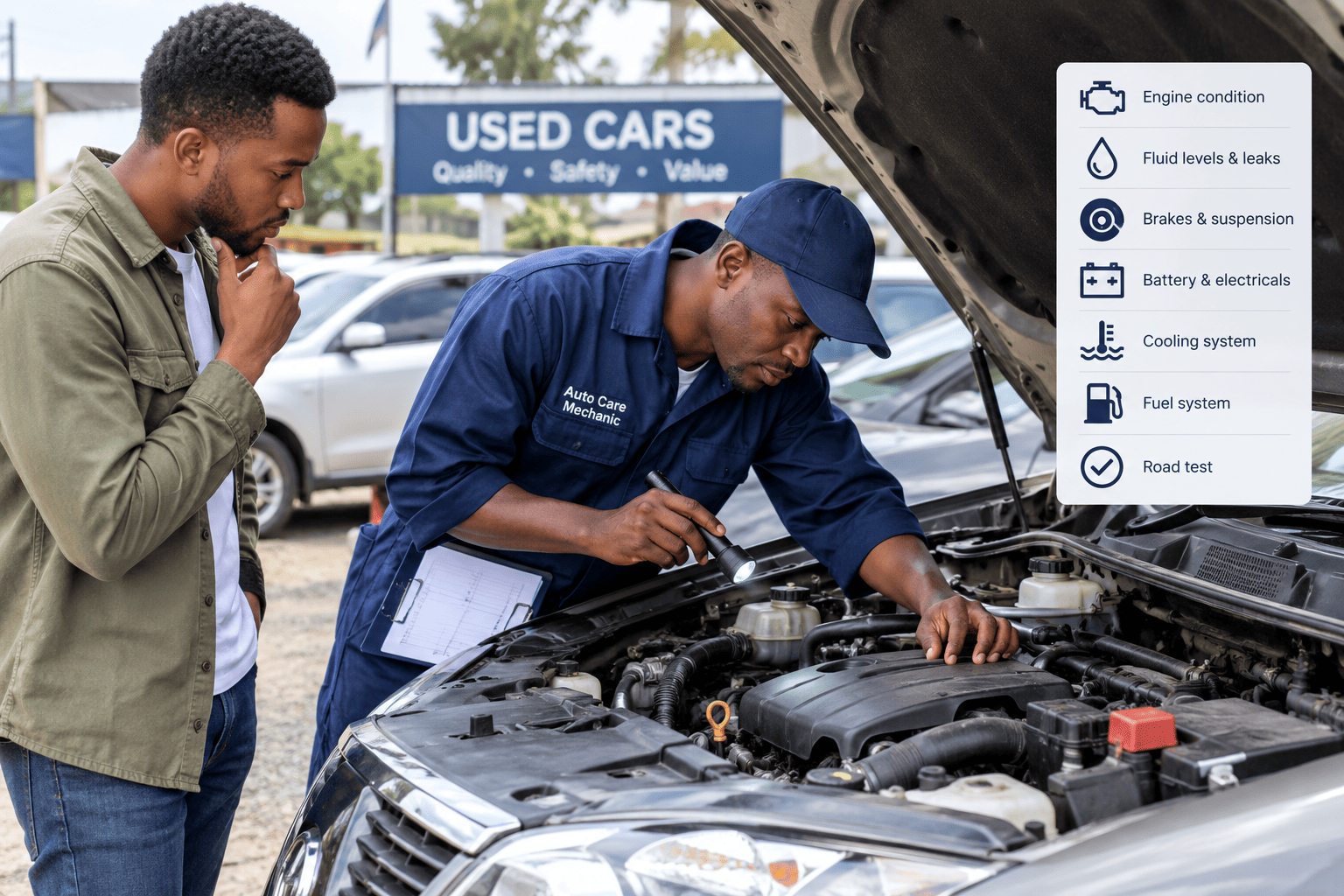
What Should a Pre-Purchase Inspection Cover?
Ask the mechanic to assess the following where applicable:
- Engine condition and unusual noises.
- Engine oil and coolant condition.
- Evidence of oil, fuel or coolant leaks.
- Fuel pump and injector operation.
- Diagnostic fault codes and warning lights.
- Transmission performance.
- Cooling-system condition.
- Suspension, steering and braking systems.
- Tyres, wheels and wheel alignment concerns.
- Battery and charging system.
- Chassis condition and signs of accident damage.
- DPF, EGR and SCR systems, where fitted.
- Signs of previous repairs or modifications.
A proper inspection should also include a road test when it is safe and appropriate.
For some vehicles, further testing may be necessary. Depending on the suspected problem, this could include compression testing, a cooling-system pressure test or specialist diagnostic checks.
Not every inspection includes every test, so agree on the scope with the mechanic beforehand.
Choose an Independent Mechanic
Where possible, choose a mechanic who is independent of the seller and has experience with the vehicle you intend to purchase.
You can ask the mechanic to:
- Identify existing faults.
- Explain which problems require immediate attention.
- Estimate likely repair costs.
- Identify maintenance that will soon be due.
- Advise whether the vehicle is worth considering at the asking price.
A mechanic cannot guarantee that a used car will never develop problems. However, an independent inspection can reduce uncertainty and help you make a more informed decision.
Do Not Rush Because of Seller Pressure
Be cautious if a seller refuses an independent inspection, prevents reasonable diagnostic checks or pressures you to pay immediately.
There may be legitimate reasons for some inspection limitations, but you should understand them before proceeding.
If a significant mechanical fault is discovered, you can negotiate based on the findings, request that the issue be resolved or decide not to purchase the vehicle.
Walking away from a problematic car may be less expensive than buying it and discovering major faults later.
8. How to Budget for Your First Used Car
The purchase price is only one part of car ownership.
Before buying, estimate the likely cost of running and maintaining the vehicle.
Consider these expenses:
- Fuel.
- Insurance.
- Routine servicing.
- Engine oil and filters.
- Tyres and battery replacement.
- Brake pads and other wear components.
- Unexpected repairs.
- Parking and tolls, where applicable.
- Statutory requirements and documentation.
- Specialist servicing for particular engine or emissions systems.
A vehicle with excellent fuel economy may still be expensive to own if its spare parts are costly or its engine has a history of reliability problems.
Likewise, a cheaper vehicle may require substantial immediate repairs.
Ask your mechanic to distinguish between essential repairs, upcoming maintenance and optional improvements. This can help you establish a realistic ownership budget.
It is also wise to keep an emergency repair reserve rather than spending your entire budget on the purchase.
9. Petrol and Diesel Fuel Economy: Look Beyond Advertised Figures
Fuel consumption is influenced by several factors, including engine size, vehicle weight, transmission, driving style, road conditions and maintenance.
A diesel model may consume less fuel than a comparable petrol model, but the difference varies considerably between vehicles.
Urban traffic can increase consumption because of frequent acceleration, idling and braking. Long-distance highway driving may produce different results.
Poor tyre pressure, dragging brakes, incorrect wheel alignment and neglected maintenance can also increase fuel consumption.
When comparing two used vehicles, consider:
- Real-world fuel consumption reported by owners of the same model and engine.
- The type of driving you normally undertake.
- The cost of common repairs.
- Availability and cost of spare parts.
- Maintenance requirements.
- The vehicle’s actual mechanical condition.
Avoid choosing a car solely because a seller advertises exceptionally low fuel consumption. Ask how the figure was obtained and whether it reflects realistic driving conditions.
10. Common Mistakes to Avoid When Buying a Used Car in Kenya
First-time buyers can reduce their risk by avoiding several common mistakes.
Mistake 1: Buying based on appearance alone
A polished exterior and clean interior do not prove that the engine, transmission or chassis is in good condition.
Mistake 2: Assuming a low odometer reading guarantees reliability
Mileage should be assessed alongside maintenance records, the vehicle’s overall condition and available inspection information.
Mistake 3: Ignoring warning lights
A warning light may indicate a fault that requires further diagnosis. Do not assume that it will disappear after purchase.
Mistake 4: Choosing an unfamiliar model without researching spare parts
Some vehicles may be difficult or expensive to maintain locally. Research the availability of parts and qualified technicians before committing.
Mistake 5: Ignoring fuel specifications
Always confirm the correct fuel grade and type for the engine.
Mistake 6: Skipping an independent inspection
A pre-purchase inspection can identify existing faults and provide a better basis for negotiation.
Mistake 7: Spending the entire budget on the purchase
Keep money available for insurance, servicing, documentation and unexpected repairs.
Mistake 8: Assuming every diesel engine is more economical
Fuel economy depends on the particular engine, vehicle, driving conditions and maintenance history.
Mistake 9: Ignoring emissions-system condition
If the vehicle has a DPF, EGR or SCR system, establish whether it is functioning correctly and whether any warning lights or fault codes are present.
Mistake 10: Failing to verify the vehicle’s documentation
Confirm the vehicle’s identity, ownership records and relevant documentation through the appropriate official channels before completing the transaction.
11. A Practical Used-Car Buying Checklist
Before paying for a used car, work through this checklist.
Vehicle History
- Review available service and maintenance records.
- Check the recorded mileage for inconsistencies.
- Examine available import and ownership documentation.
- Investigate any reported accident history.
- Confirm the vehicle’s identity and relevant registration details.
Engine and Mechanical Condition
- Arrange an independent pre-purchase inspection.
- Check for unusual engine noises.
- Investigate oil or coolant leaks.
- Assess starting and idle performance.
- Check for persistent exhaust smoke.
- Scan for relevant diagnostic fault codes.
- Inspect the transmission, brakes, steering and suspension.
- Check emissions-control systems where fitted.
Fuel and Maintenance
- Confirm whether the engine uses petrol or diesel.
- Verify the manufacturer’s recommended fuel specification.
- Establish the correct engine oil requirements.
- Review service intervals and upcoming maintenance.
- Research local spare-parts availability.
- Estimate routine servicing and likely repair costs.
Financial Readiness
- Calculate the total cost of ownership.
- Obtain an insurance estimate.
- Budget for immediate maintenance.
- Keep an emergency repair reserve.
- Avoid paying a non-refundable deposit before completing the necessary checks.
This checklist cannot eliminate every risk, but it provides a structured way to assess a vehicle before committing your money.
12. Finding Vehicle Inspection, Repair and Spare-Parts Services in Kenya
Buying a used vehicle is only the beginning of ownership. Access to reliable mechanics, inspection services and suitable spare parts can influence how much you spend on maintenance over time.
Before purchasing a vehicle, identify service providers who understand its make and engine type.
You can use TrustRank Kenya to explore relevant automotive businesses and compare available services.
Consider browsing the following categories on TrustRank Kenya:
- Vehicle inspection services in Kenya.
- Motor vehicle repair and maintenance services.
- Automotive spare parts suppliers.
Add links to the corresponding TrustRank Kenya category pages when they are available.
When comparing service providers, consider their experience with your particular vehicle, the services offered, diagnostic capabilities, location and ability to explain repair findings clearly.
For major repairs, ask for an explanation of the fault and a written estimate where possible. If a repair is expensive or the diagnosis is unclear, a second opinion may be worthwhile.
13. Frequently Asked Questions About Used Cars in Kenya
Is a petrol or diesel car better for a first-time car owner in Kenya?
Neither is automatically better. Petrol cars may be suitable for many urban drivers, while diesel vehicles can suit frequent long-distance travel and demanding workloads. The best choice depends on the vehicle’s condition, maintenance requirements, fuel economy and the owner’s budget.
Can adulterated diesel damage an engine?
Yes. Depending on the contaminant and its concentration, unsuitable diesel can affect combustion, fuel-system lubrication and injector operation. The severity of the damage varies, so suspected contamination should be investigated promptly.
How can I tell whether my car has used contaminated fuel?
Possible symptoms include sudden loss of power, rough running, difficult starting, unusual exhaust smoke and warning lights after refuelling. However, these symptoms can have other causes. A qualified mechanic should diagnose the problem.
Does Kenyan fuel damage imported cars?
Imported cars are not automatically incompatible with Kenyan fuel. The important considerations are fuel quality, the manufacturer’s specifications, engine design and proper maintenance. Confirm the required fuel grade before buying or operating a vehicle.
Are modern diesel cars expensive to maintain?
Some modern diesel vehicles can be expensive to repair, particularly when their high-pressure fuel systems or emissions-control equipment develop faults. Costs vary by make, model, engine and parts availability.
Should I inspect a used car before paying for it?
Yes. An independent pre-purchase inspection can identify existing mechanical problems, safety concerns and likely repair costs. It can also help you decide whether the asking price is reasonable.
Is high mileage always a reason to avoid a used car?
No. Mileage is one factor among several. A well-maintained vehicle with higher mileage may be a better choice than a poorly maintained vehicle with a lower reading. Review the service history and obtain an independent inspection.
What is the most important maintenance practice for a used car?
There is no single practice that prevents every problem. Following the manufacturer’s servicing schedule, using the correct engine oil and fuel, maintaining the cooling system and addressing warning signs promptly are all important.
Should I buy a diesel vehicle that has a DPF warning light?
Do not assume the problem is minor. Ask a qualified mechanic to diagnose the warning and assess the DPF and related systems before you buy. The repair cost depends on the underlying fault.
How much should I budget for used-car maintenance?
The amount varies by vehicle, age, mileage, parts availability and driving conditions. Obtain estimates for routine servicing and common repairs for the exact model you intend to purchase, then keep an additional reserve for unexpected expenses.
Conclusion: Make an Informed Used-Car Purchase
Choosing a used car in Kenya involves more than deciding between petrol and diesel. Fuel quality, engine design, maintenance history, spare-parts availability and the condition of the vehicle all affect long-term ownership costs.
Petrol vehicles can be practical for everyday urban driving, while diesel vehicles may suit motorists who regularly travel long distances or carry heavy loads. Both can provide reliable service when properly selected and maintained.
Pay attention to the manufacturer’s fuel specifications, purchase fuel from reputable suppliers and investigate unusual engine symptoms promptly. If you are a first-time car owner, arrange an independent inspection before paying for the vehicle.
Most importantly, avoid rushing into a purchase because the car looks attractive or the asking price seems affordable. A careful inspection and realistic maintenance budget can help you choose a vehicle that better suits your needs.
Explore TrustRank Kenya to discover vehicle inspection providers, mechanics and automotive spare-parts businesses that can help you make more informed decisions about car ownership.